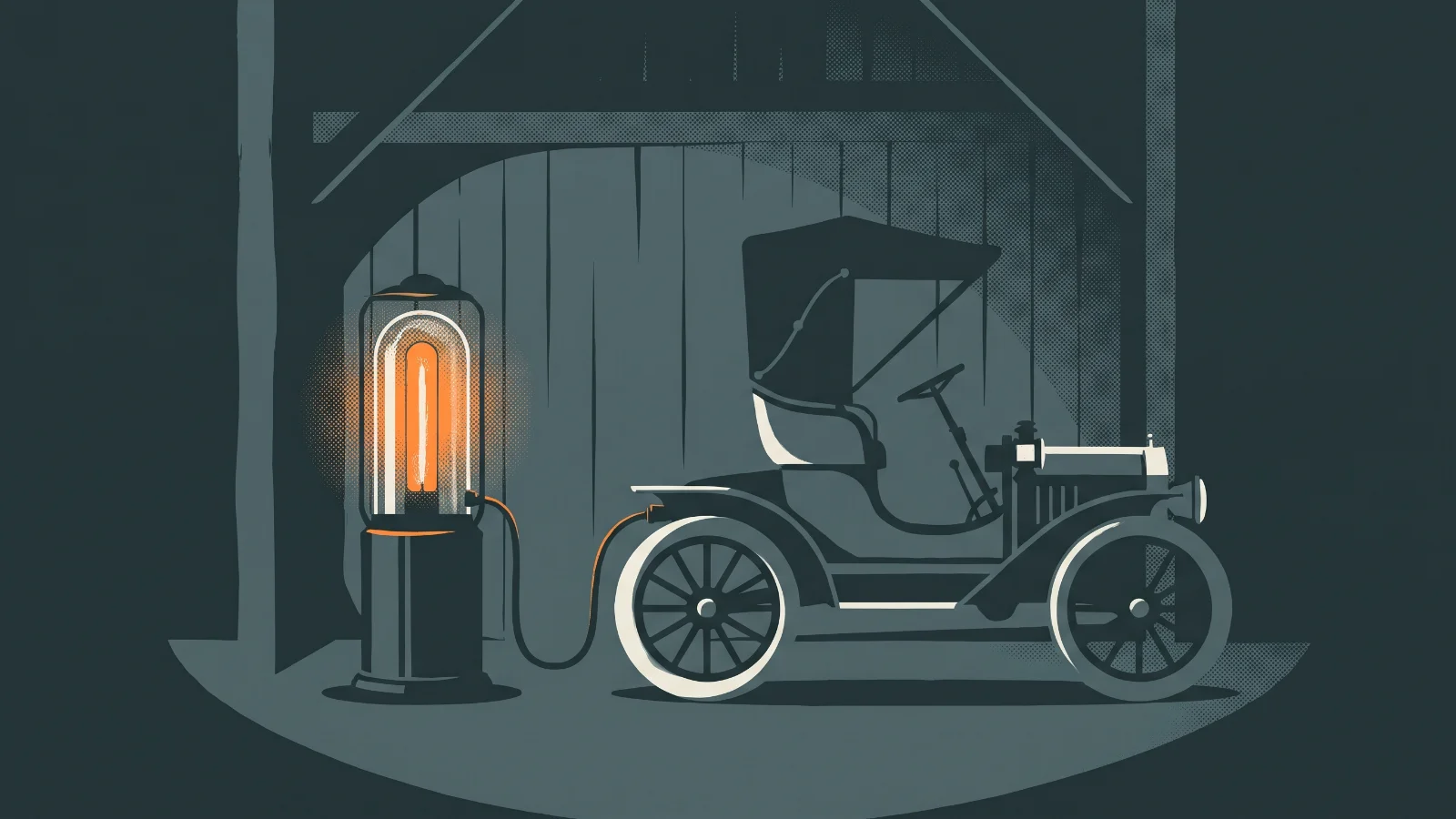
At the turn of the 20th century, the early automobile industry saw fierce competition between steam, internal combustion, and electric technologies. While gasoline cars required manual hand-cranking and emitted noxious fumes, fully electric vehicles were easy to start and operated without foul exhaust. Because of these convenient attributes, electric cars were actively marketed to women and to doctors who needed to make quiet house calls at night.
Fannie Goodnow, an early adopter of this technology, owned a 1908 Bailey Victoria Phaeton produced by S.R. Bailey & Co. To charge her vehicle, she utilized a General Electric mercury-arc rectifier, a device based on electrical engineer Peter Cooper Hewitt's mercury vapor lamp. This charging unit functioned as a diode to convert alternating current from the power grid into direct current, taking about 12 hours to fully charge a drained battery.
Initially, the automaker attempted to use an alkaline battery designed by Thomas Edison, but early versions leaked and failed to hold a charge. The company temporarily pivoted to lead-acid batteries from Gould Storage Battery Co., which provided a range of 64 to 80 kilometers and brought the car's cost to 2,000 dollars.
Edison eventually improved his battery design by 1910, prompting S.R. Bailey & Co. to use it in a 1,600-kilometer publicity tour. However, they could not compete against the rising dominance of internal combustion engines like the Model T. After producing between 500 and 600 electric vehicles, the company sold its factory in 1915.